
Where to buy real Delft Blue, and how to tell it from souvenir copies
September 3, 2026 · by Robin Lenskens
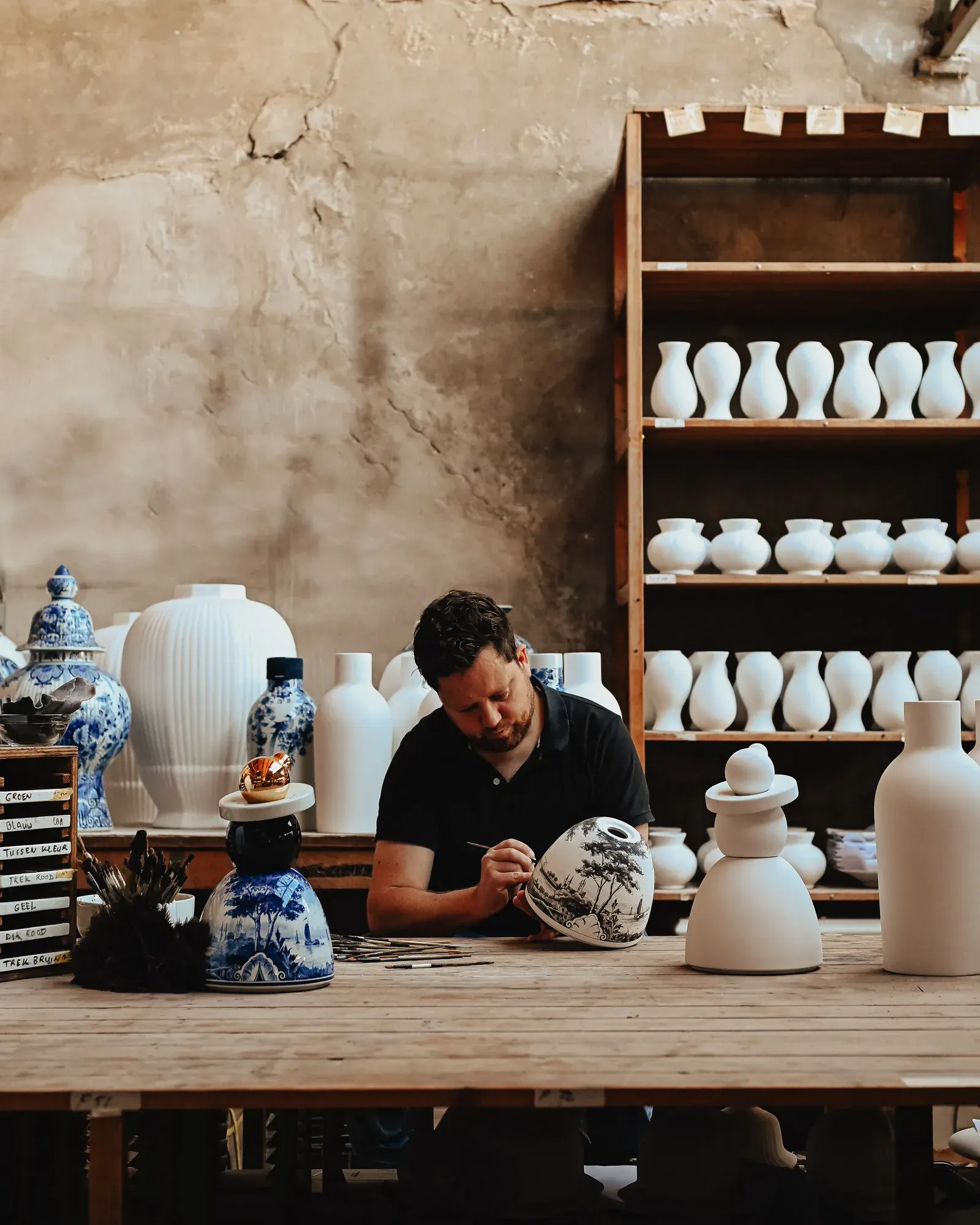
Real Delft Blue is hand-painted earthenware made in Delft, and the only 17th-century factory still producing it is Royal Delft (De Koninklijke Porceleyne Fles, founded 1653) on the Rotterdamseweg, a 15 to 20 minute walk from the station. You can also buy hand-painted work at the Heinen Delfts Blauw shops on the Markt, and old pieces at the Saturday antiques market from April onwards. Everything else sold as “Delft Blue” in the Netherlands, from airport tulip vases to €5 clogs, is printed, cast, or made abroad. This guide tells you how to tell the difference before you pay.
What counts as real Delft Blue?
Real Delft Blue is tin-glazed earthenware, painted by hand with a cobalt pigment that turns blue in the kiln, and made in Delft. That is the tradition Delft potters developed in the 1600s when they copied the blue and white Chinese porcelain arriving with the Dutch East India Company, and it is the tradition Royal Delft says it has kept unbroken since 1653.
Three things follow from that definition:
- Hand-painted, not printed. A painter works with a brush on the unfired glaze. No two pieces are identical.
- Made in Delft. “Delft Blue” is not a protected name, so a mug made anywhere in the world can carry the words. The factory location is what you are checking, not the label.
- Marked on the bottom. Genuine makers sign their work. Royal Delft has used a standard mark since 1879: a small jar, the initials JT, and the word Delft, plus the painter’s initials on the lower left and a year code letter on the lower right. The year code chart on royaldelft.com lets you date any piece to the year.
If a piece has no painter’s initials, no year code and a flawlessly repeated pattern, it is not hand-painted Delftware, whatever the shop says.
Why is real Delft Blue made in Delft and not in Amsterdam?
Because Delft is where the potteries were. In the 17th century the city had more than thirty earthenware factories, many of them set up in former breweries along the canals. Amsterdam was the trading port that shipped the finished plates around the world, which is why so many visitors still associate the blue and white style with Amsterdam. The painting itself has always happened in Delft.
Today the shops on Amsterdam’s canal ring and at Schiphol sell a mix: some hand-painted pieces from Delft makers, and a great deal of printed souvenir ware. If you want to see a painter at work and buy from the source, you come to Delft. It is under an hour from Amsterdam by train.
Where to buy real Delft Blue in Delft
Royal Delft (De Koninklijke Porceleyne Fles)
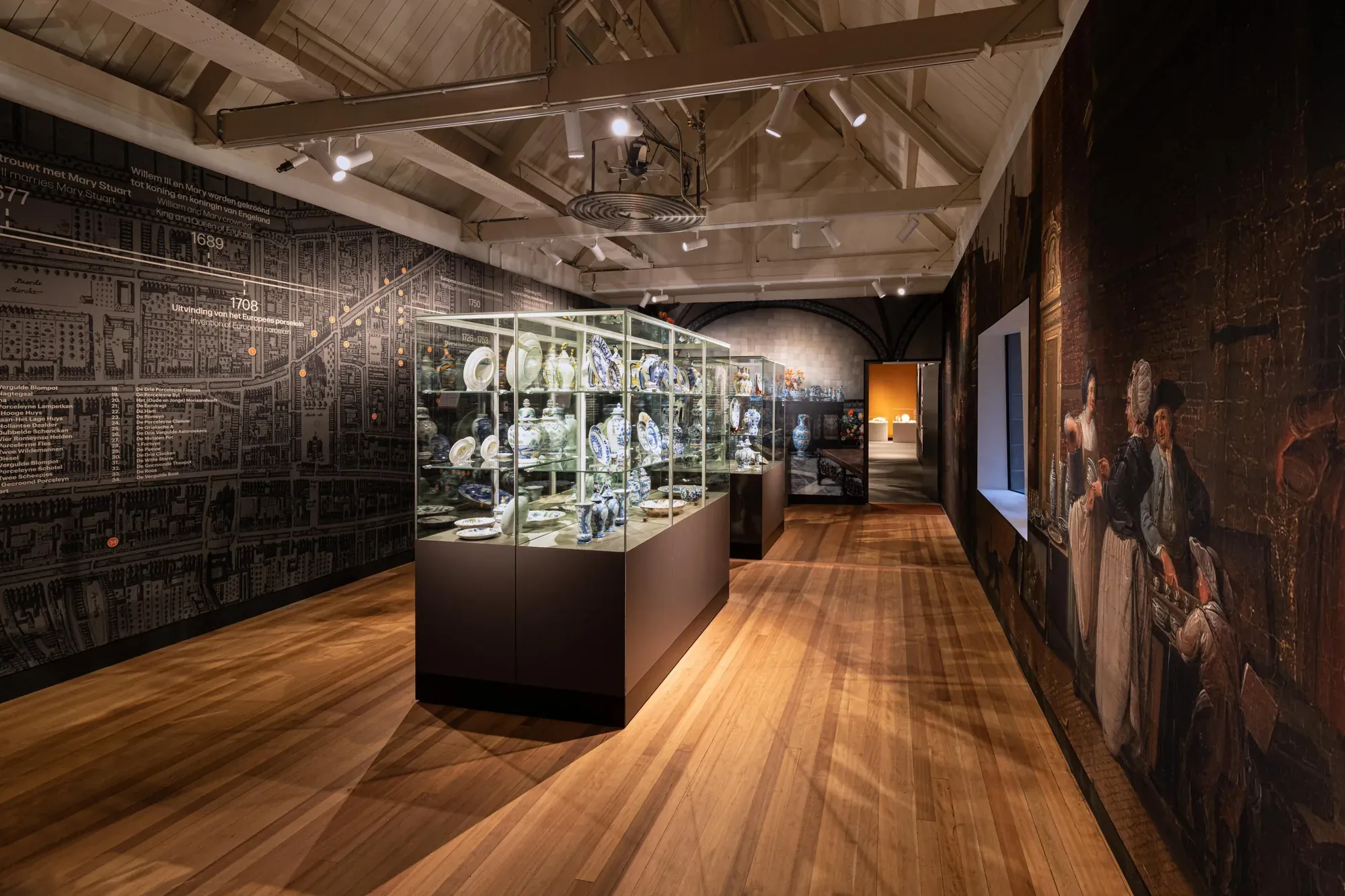
Royal Delft is the factory, museum and flagship shop in one building at Rotterdamseweg 196. The museum calls itself the only remaining Delft Blue factory from the 17th century, and the visit takes you past painters at work, the kilns and the historic collection, including pieces made for the royal family.
| Detail | |
|---|---|
| Address | Rotterdamseweg 196, Delft |
| Opening hours | Daily 09:30–17:00 (from 09:00 between 1 April and 15 May); closed 25 and 26 December and 1 January |
| Museum ticket | €17.50 adult, €11.50 student, €7.50 child 7 to 12, free under 7 |
| Museumkaart | Free entry |
| Included | Museum, factory route, audio tour in eight languages |
| Shop | Free to enter without a ticket |
Prices and hours are from the Royal Delft Museum visitor page and can change, so check before you go. Every hand-painted piece in the shop comes with a certificate of authenticity, and the shop ships worldwide. Tiles start at about €25, though not hand-painted ones. Hand-painted work in this shop starts at about €100 for a 13 cm tile and €190 for a 14 cm plate; a hand-painted 23 cm plate is €500, and hand-painted vases run from several hundred to several thousand euros depending on their size. If those numbers seem high, remember that a painter has spent hours on each one.
Our Delft and Royal Delft tour includes the museum entry and a tuktuk there and back from the historic centre, which solves the “where exactly is it” problem and follows the road the old potteries used to line. The visit inside is self-guided, with an audio guide.
Heinen Delfts Blauw
Heinen is a family company that began in 1975 and now describes itself as the largest producer of Delft Blue in the world, with ateliers in Delft and Putten and factories in the Netherlands and China. That last point matters: Heinen sells both exclusive hand-painted pieces and machine-made Home & Living lines, and the price tag tells you which is which.
The Delft shops are all in the centre:
- Blue Classics, Markt 45 (the traditional hand-painted range)
- Concept Store, Hippolytusbuurt 3
- Outlet, Markt 30
Ask the staff to point out the hand-painted pieces and turn one over: you should see a hand-applied mark rather than a printed logo, and slight differences between two “identical” items.
De Delftse Pauw: no longer open
Older guidebooks still list De Delftse Pauw on the Delftweg as a second factory to visit. It was taken over by Heinen in 2018 and declared bankrupt in September 2020, and the site is closed. Do not plan a visit around it.
Museum and gallery shops
The shop at the Vermeer Centrum on the Voldersgracht carries Delftware alongside Vermeer books and prints. Museum Prinsenhof is closed for renovation until at least 2027, and its shop with it, though the small Winkeltje Kouwenhoven sweet shop next to the museum entrance stays open. Several independent galleries in the streets around the Markt sell contemporary Delft ceramics by studio potters, which is worth a look if you want something modern rather than a reproduction of a 1700s plate.
Antique Delftware at the Saturday market
From April, the Saturday antiques, curiosa and book market fills the canalsides around the Oude Kerk, the Voldersgracht, Wijnhaven and Hippolytusbuurt, roughly 10:00 to 16:00, with well over a hundred stalls. The municipality lists the season as April to October and the tourist office as April to September, so treat late-season Saturdays as “probably” and check the Delft municipality’s market page if you are travelling in October.
You will find genuine 18th and 19th-century plates and tiles here, often with chips and crazing, and priced accordingly. A few rules for buying old pieces:
- A crack or chip is normal on a 200-year-old plate and should be reflected in the price.
- Old tin-glaze has a soft, slightly uneven surface and a warm off-white tone; a bright, glassy white with a flat blue print is modern.
- Marks on antique Delftware are inconsistent, so do not expect the neat Royal Delft mark. Ask the dealer what they know about the piece and whether they will write it on the receipt.
Delft also has established antique dealers with permanent shops in the centre. Prices are higher than at the market and provenance is usually better documented.
This is also the cheapest way to own something genuinely hand-painted. An antique tile, one or two hundred years old and sometimes closer to three, in a dull faded blue with a chipped edge and visible wear, sells for around €50 from dealers in the centre. The same tile in good condition costs more. A newly hand-painted tile depends on who made it: Heinen’s simplest hand-painted tiles start around €33, below the antique, while Royal Delft’s start at about €100. If you want real hand-painted Delftware and the factory prices are out of reach, an imperfect old tile is the honest answer.
How do I spot a printed copy?
Turn the piece over first, then look at the decoration under good light. Printed or transfer-decorated “Delft Blue style” pieces give themselves away in four ways:
- Dots and grids. A print is made of tiny dots or a fine screen. Look closely at a shaded area: hand-painting shows brush strokes that fade in and out, a print shows a regular texture.
- Perfect repetition. Pick up two of the same item. If every leaf and windmill sail is in exactly the same place, they came from the same transfer.
- No brush texture. Run a finger over the surface. Hand-painted cobalt sits slightly proud of or into the glaze in places; a print is dead flat.
- The mark. No painter’s initials, no year code, a logo that looks stamped, or a sticker reading “hand-decorated” (which can mean a hand-applied transfer). “Made in Delft” printed on the base of a €6 mug should make you suspicious rather than reassured.
None of this makes printed pieces bad. A printed tile is a perfectly good €5 souvenir. The problem is paying hand-painted prices for it.
What does real Delft Blue cost?
Rough guide. The new pieces were checked in September 2026 against the Royal Delft and Heinen Delfts Blauw webshops; the antique prices come from the dealers in the centre. Check in the shop, prices change:
| Type | Typical price |
|---|---|
| Printed souvenir tile, mug or clog | €3 to €15 |
| Small tile or ornament, not hand-painted | €25 to €60 |
| New hand-painted tile, 13 cm | €33 to €100, depending on the maker |
| Antique hand-painted tile, worn or chipped | from about €50, more in good condition |
| Hand-painted plate, 18 to 25 cm | €250 to €500 |
| Hand-painted jug, or a hand-painted plate around 29 cm | €330 to €650 |
| Hand-painted vase | several hundred to several thousand euros, depending on the size |
| Large showpieces and limited editions | €1,500 upwards |
| Antique plate at the Saturday market | €20 to a few hundred, condition dependent |
Can I ship it home and get the VAT back?
Yes on both counts. Royal Delft and the larger shops pack and ship worldwide, and for a big vase that is far safer than your suitcase. Ask about insurance and delivery time when you buy.
If you live outside the EU, you can reclaim Dutch VAT on purchases of at least €50 from a participating shop, provided you take the goods out of the EU within three months of the month of purchase. Since 1 January 2026 the shop registers your invoice digitally with your name and passport number, and you validate it with Customs at your departure airport or port, showing the unused goods. The refund itself comes from the shop or its refund partner, not from Customs, and not every shop takes part, so ask before you pay. Full rules are on the Dutch Customs VAT refund page.
Is it worth going to Royal Delft if I am not buying anything?
Yes, if you like seeing things being made. Watching a painter lay down a cobalt line that will only turn blue after firing is the part most visitors remember, and the museum explains why the Delft potters were copying Chinese porcelain in the first place. Allow 60 to 90 minutes. If you have a Museumkaart it is free, and if you are short on time the shop and painting demonstration area are the priority.
If you are more interested in Vermeer than in ceramics, put your time into the Vermeer’s Delft tour instead and stop at the Heinen shop on the Markt for a hand-painted piece on the way.
Frequently asked questions
Is Delft Blue porcelain?
No. Delft Blue is earthenware with a white tin glaze, painted to look like Chinese porcelain. Real porcelain is fired at a higher temperature and is harder and more translucent. This is why old Delftware chips more easily than a porcelain plate, and why a chipped edge on an antique piece shows a reddish or buff clay underneath rather than white.
Does “Delft Blue” on the label mean it was made in Delft?
No. The name is not protected, so it describes a style rather than an origin. Check the bottom mark for a maker’s name, painter’s initials and year code, and ask the shop where the piece was painted. Royal Delft is the only factory that paints inside the city on the 1653 site.
How do I read the Royal Delft bottom mark?
The central mark is a small jar, the letters JT and the word Delft. Below it, the initials on the left are the painter’s, and the letter or letters on the right are the year code. Royal Delft publishes the code list online, so you can date a piece to the year and, with the painter list, to the individual painter.
Can I paint my own Delft Blue?
Yes. Royal Delft runs painting workshops in the museum where you decorate a tile or plate under a painter’s instruction and it is fired and sent to you afterwards. Book ahead, especially at weekends and in the tulip season. Heinen also runs workshops, mainly in Putten rather than Delft.
Is it cheaper to buy Delft Blue in Delft than in Amsterdam?
For hand-painted Royal Delft, prices are set by the maker and are the same in its own shop and at authorised dealers, so the saving is small. The real advantage of buying in Delft is choice and certainty: you see the full range, you can watch it being painted, and you are not sorting through printed souvenirs to find the genuine pieces.
Are the antiques market pieces really antique?
Mostly, but not always, and “antique” covers everything from 1700 to 1950. Buy what you like at a price you are happy with, look for the signs of tin glaze and hand-painting described above, and ask the dealer to write the date and origin on your receipt.
See Delft with a Discover Delft guide
Our guides know which shops sell what, and the Delft and Royal Delft tour takes you from the historic centre to the factory by tuktuk, with the museum entry included. For a shorter visit that stays in the old town, the private walking tour of Delft runs two hours and starts when you want. Cruise passengers arriving in Rotterdam can do the same visit in a morning with the Delft and Royal Delft shore excursion. Our guides work in English, Dutch, German, French, Italian and Spanish.
Ready to see Delft with a private guide?
See our tours