Why Rotterdam looks nothing like the rest of the Netherlands
September 9, 2026 · by Robin Lenskens
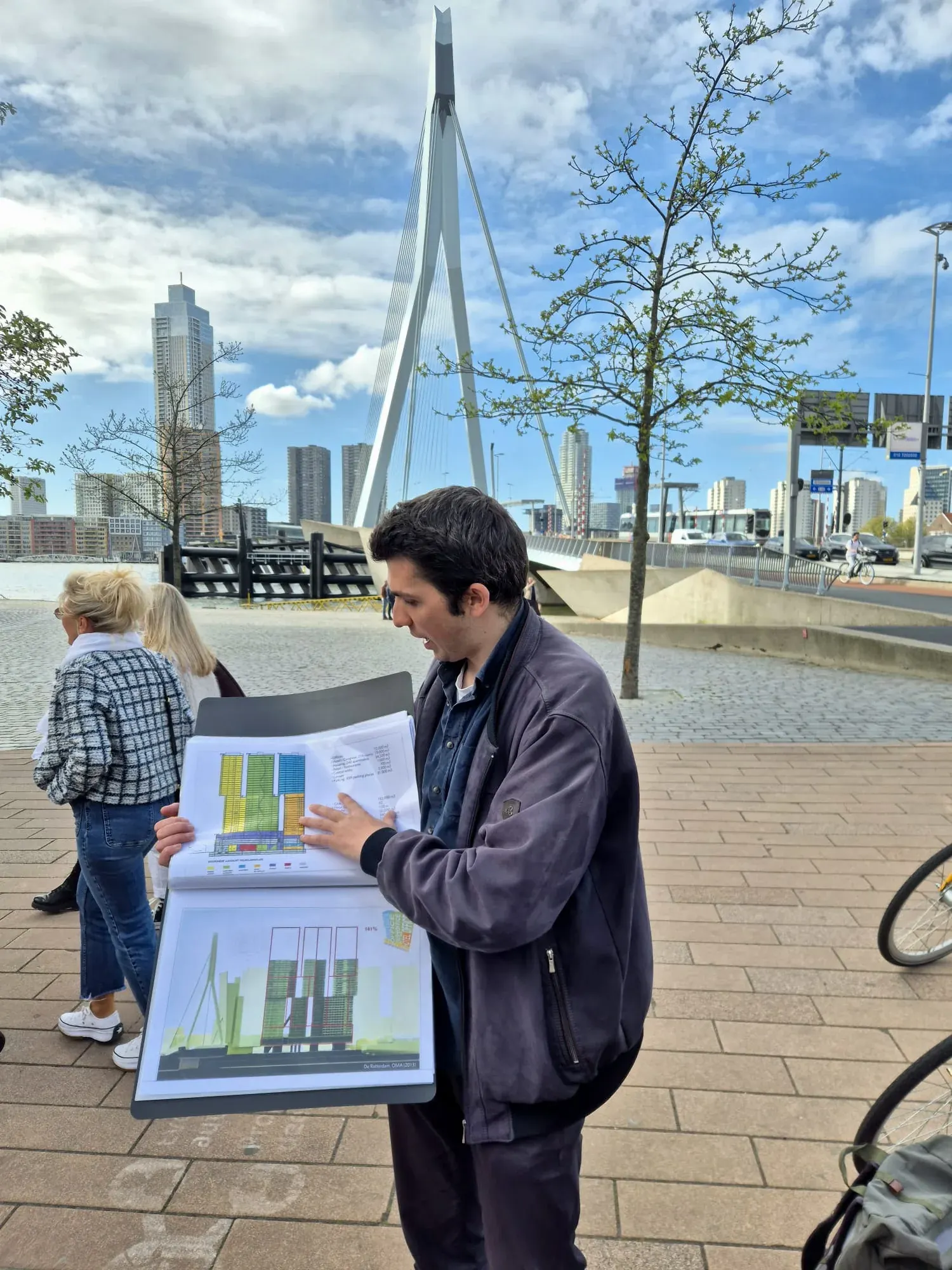
Every other Dutch city centre is a picture of the 17th century. Rotterdam is a picture of the 21st, and it is not because the city chose to be modern. It is because on the afternoon of 14 May 1940 the old town stopped existing, and because the men who rebuilt it decided, deliberately and against a lot of public feeling, not to put it back the way it was.
The short answer
- Why does Rotterdam look so modern? German bombers destroyed the medieval centre on 14 May 1940. The post-war plan rebuilt it as a modern city rather than reconstructing what was lost.
- What is Rotterdam known for? The largest port in Europe, and the boldest architecture in the Netherlands: the Cube Houses, the Erasmus Bridge, the Markthal, the Euromast.
- Where does the name come from? From a dam built on the little river Rotte in the 13th century. Rotterdam received city rights in 1340.
A dam, a river and a very good position
The Rotte is a small river. Around 1270 the people living along it built a dam where it met the much bigger Nieuwe Maas, and a settlement grew on top of the dam. That is the whole etymology: Rotte plus dam. The same pattern gave the country Amsterdam, Zaandam and Schiedam.
City rights followed in 1340, together with permission to dig a canal to the Schie, which connected the new town to the inland trade routes and to Delft. Rotterdam spent the next 300 years as a competent second-tier port: herring, then trade with England and the Baltic, then a chamber of the Dutch East India Company.
Two things made it enormous. The first was the Ruhr, filling up with coal and steel through the 19th century and needing a coastal outlet. The second was the Nieuwe Waterweg, a canal cut straight through the dunes to the sea, opened in 1872 to the design of the engineer Pieter Caland. It gave the city a deep, reliable, tide-free connection to the North Sea, and the port grew along the water for the next century until it was the largest in the world, a position it held from 1962 until Shanghai and Singapore overtook it in the 2000s. It is still comfortably the largest in Europe.
One more piece of the old story is worth knowing. In 1620 a group of English separatists sailed from Delfshaven, then a village belonging to Delft and now a district of Rotterdam, on the first leg of the journey that ended with the Mayflower and the Plymouth colony. The church they prayed in is still there, and so is the harbour, because Delfshaven is one of the few corners of Rotterdam the war left alone.
14 May 1940
The Netherlands had been at war for four days. German forces held the north bank of the river but could not break Dutch resistance at the bridges, and an ultimatum was sent demanding the city’s surrender. While negotiations were still running, the bombers came.
The raid lasted about a quarter of an hour. Roughly 850 people were killed, around 80,000 were left without a home, and about 24,000 houses were destroyed, most of them by the fires that the bombing started and that burned unchecked for days because the water mains had gone. The medieval centre, the Laurenskerk, the town hall square, the old harbours: gone in an afternoon. The Netherlands surrendered the following day, in part under the threat that Utrecht would be next.
You can trace exactly what was lost. A line of steel and light markers, the Brandgrens or fire boundary, is set into the pavement across the city and follows the edge of the burnt zone. Standing on it is the single most effective thing a visitor can do in Rotterdam, because on one side of the line the houses are from 1900 and on the other side nothing is older than you are.
The decision not to rebuild
Clearing began within days, which even at the time struck people as indecent haste. By 1946 the city had adopted the Basisplan of the urban planner Cornelis van Traa, and its central choice was that the old street pattern would not return. Wider roads, separated functions, light and air, and modern architecture: the ideas of the pre-war avant-garde, applied to an entire city centre because there was nothing in the way.
The results still divide people, and it is worth seeing them in order:
| Year | Building | Why it matters |
|---|---|---|
| 1953 | Lijnbaan | The first purpose-built pedestrian shopping street in Europe, copied across the continent |
| 1960 | Euromast | Built for a horticultural expo, later raised to 185 metres, still the best view in the city |
| 1984 | Cube Houses | Piet Blom’s tilted yellow houses, a village on stilts above a road |
| 1996 | Erasmus Bridge | Ben van Berkel’s asymmetric pylon, known as the Swan, and the image the city sells itself with |
| 2013 | De Rotterdam | Rem Koolhaas and OMA’s stacked towers on the Kop van Zuid, the largest building in the country |
| 2014 | Markthal | A market hall inside an arch of flats, with a painted ceiling you will photograph |
| 2014 | Centraal Station | The station as a statement, pointing at the centre like a wedge |
| 2021 | Depot Boijmans Van Beuningen | The world’s first publicly accessible art storage building, a mirrored bowl in the park |
The Laurenskerk, the one medieval survivor, was restored over decades and reopened in 1968. It stands now among 1950s blocks, which tells you the whole story without a word of commentary.
The city the port built
Rotterdam has always been a working city rather than a pretty one, and its population reflects a century of labour migration through the docks: more than 170 nationalities, and a majority of residents with a migration background. The food, the music and the street life follow from that. So does a certain bluntness. The local saying is that Amsterdam has the beautiful people and Rotterdam does the work, usually delivered by someone from Rotterdam.
For a visitor coming from Delft, the practical picture is simple: 12 minutes by train, a completely different country at the other end.
Frequently asked questions
Why was Rotterdam bombed in 1940?
The German advance had stalled at the river crossings, and the bombing was intended to force the city’s surrender while negotiations were still in progress. Rotterdam capitulated, and the Netherlands as a whole surrendered the next day.
Is anything left of old Rotterdam?
Yes, in three places. Delfshaven, west of the centre, survived almost intact with its old harbour and the Pilgrim Fathers’ church. The Laurenskerk was rebuilt from its ruins. And the Witte Huis of 1898, briefly the tallest office building in Europe, still stands beside the Oudehaven with the Cube Houses looking down on it.
Is Rotterdam worth visiting?
If you like architecture, food and cities that are visibly alive, very much so. If you came to the Netherlands for gables and canals, do Delft first and treat Rotterdam as the counterweight. Half a day is enough for the highlights, a full day if you go up the Euromast and into the Depot.
How far is Rotterdam from Delft?
About 12 minutes by direct train, with several an hour. Rotterdam Centraal to Delft station, no changes.
What is the Brandgrens?
The fire boundary: a marked line through the streets showing the edge of the area destroyed on 14 May 1940. It is set into the pavement in steel and light, and it runs for about 12 kilometres.
See Rotterdam with a guide
The Rotterdam tours run under our sister brand Holland City Tours. The private walking tour of Rotterdam covers the Brandgrens, the Markthal, the Cube Houses and the bridge in about two and a half hours, private to your party and in your own language. If you are based in Delft and want both in a day, ask us about the combined Delft and Rotterdam itinerary when you book.
Ready to see Delft with a private guide?
See our tours