
Vermeer's Delft: where to stand today to see the painter's city
September 3, 2026 · by Robin Lenskens
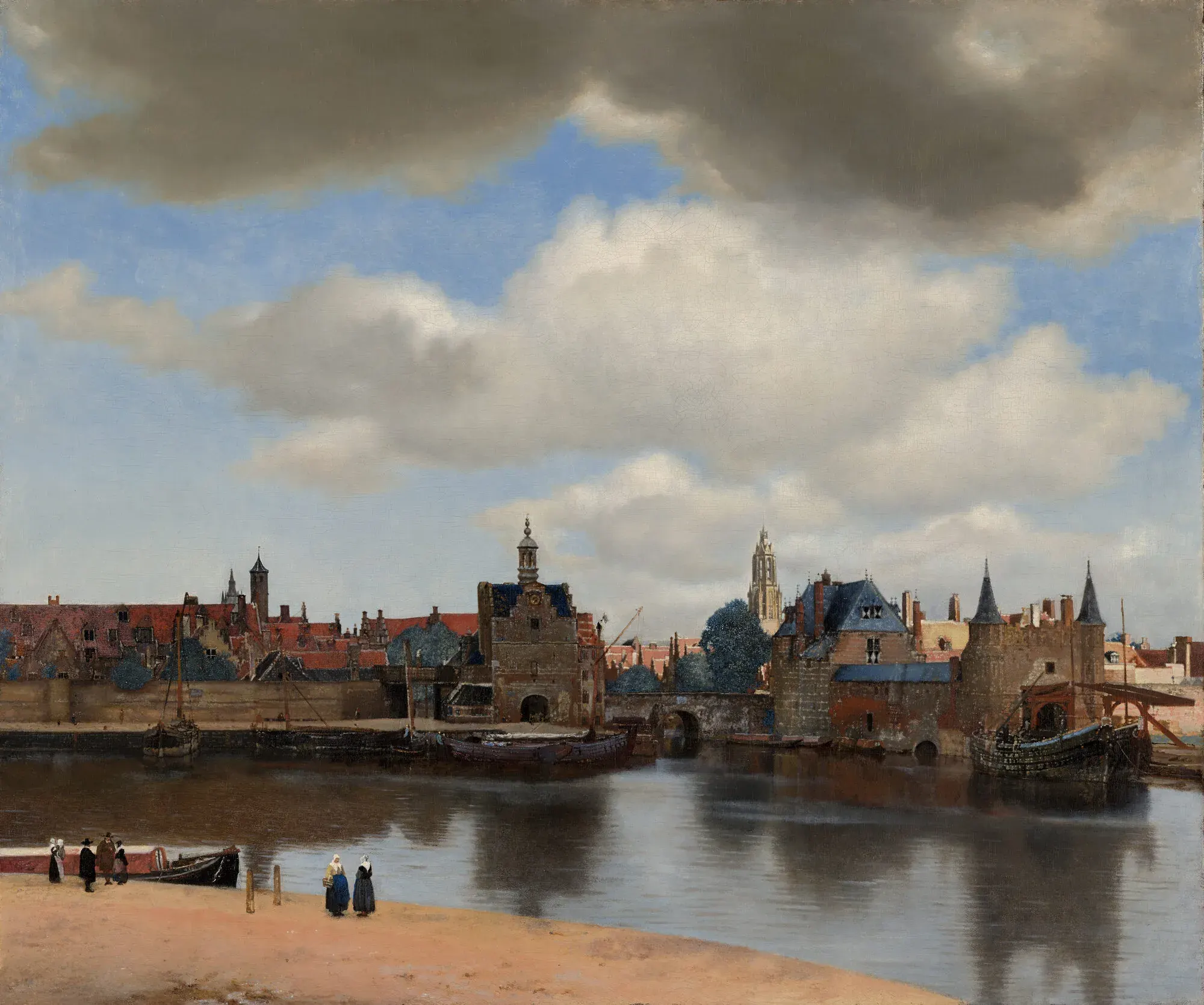
Johannes Vermeer was born in Delft in 1632, baptised in the Nieuwe Kerk, painted here all his life, and was buried in the Oude Kerk in December 1675. Almost every place in his story is still a place you can walk to in ten minutes from the Markt: the inn where he grew up, the guild where he registered as a master, the quay where he stood for the View of Delft, and the two houses in the Little Street. What Delft does not have is a single original painting. This guide tells you where to stand in Delft, and then where to go for the paintings themselves.
Did Vermeer really never leave Delft?
As far as the records show, he lived his whole 43 years in the city. He was baptised in the Nieuwe Kerk on 31 October 1632, joined the painters’ Guild of St Luke in 1653, served twice as its head, married Catharina Bolnes, fathered a large family, and died in 1675 leaving his wife with eleven children and serious debts. His output was small, probably two or three paintings a year, and his reputation faded after his death until the French critic Théophile Thoré-Bürger revived it in the 19th century. Today about 37 paintings are accepted as his, and none of them is in Delft.
That makes Delft a different kind of Vermeer visit from Amsterdam or The Hague. You come here for the light, the brick, the canals and the exact spots, not for the canvases.
Where do I stand for the View of Delft?
On the Hooikade, on the south side of the Kolk, the old harbour basin just south of the historic centre and a few minutes’ walk from the station. Vermeer painted the city from here around 1660 to 1661, looking north across the water at the Schiedam and Rotterdam gates with the Nieuwe Kerk tower catching the sun behind them.
Walk out of the station, turn left along the water and you are there in under five minutes. A marker on the quay identifies the spot and the Vermeer Centrum has added an installation that shows the 17th-century skyline through your phone. The gates are gone and the buildings on the far bank are 19th and 20th century, but the tower is exactly where he put it, and on a morning with broken cloud you understand why the Mauritshuis says he arranged the scene into three bands of water, city and sky. The painting itself hangs in Room 15 of the Mauritshuis in The Hague, a ten-minute train ride away.
Where is the Little Street?
Vlamingstraat 40 and 42, a quiet canal street east of the Markt. For a century and a half nobody knew where Vermeer had stood for this small painting of two brick houses and a passageway. In November 2015 Frans Grijzenhout, professor of art history at the University of Amsterdam, matched the widths of the houses and the alley against a 1667 Delft register of canal dues that recorded the frontage of every house, accurate to about 15 centimetres. The house on the right belonged to Vermeer’s widowed aunt, Ariaentgen Claes, who sold tripe from the passage, which was known as the Penspoort, the tripe gate. Vermeer’s mother and sister lived on the same canal.
The original houses are gone and what you see now is a later building on the same plots, but the canal, the width of the street and the light are the same. A small plaque marks the spot. The painting is in the Rijksmuseum in Amsterdam.
Where was Vermeer born and where did he grow up?
Two addresses, both on or beside the Markt:
- Voldersgracht 25, the Flying Fox. Vermeer’s father Reynier ran an inn here called De Vliegende Vos, and Johannes was born on this canal in 1632 and lived here until he was nine. There is a café in the building today.
- Markt 52 to 54, the Mechelen inn. In 1641 the family moved to a larger inn on the north side of the Markt, facing the Nieuwe Kerk. Vermeer grew up here, and his father also dealt in paintings from the premises. Mechelen was demolished in 1885; the site is marked.
After his marriage Vermeer lived with his mother-in-law, Maria Thins, in a house on the Oude Langendijk, on the corner of the Molenpoort, in the Catholic quarter behind the Markt. That house is also gone. Most of the interiors in his paintings, with the tiled floors and the light from the left, are thought to have been painted in an upstairs room there.
What is the Vermeer Centrum, and is it worth it?
The Vermeer Centrum Delft at Voldersgracht 21 stands on the site of the old St Luke’s Guild, where Vermeer was registered in 1653 and served as head in 1662 to 1663 and 1670 to 1671. It has no original paintings. What it offers is all of his known work reproduced at true size in one room, an explanation of his studio, his pigments and the camera obscura question, and the story of his life in this town. It is open daily 10:00–17:00, €15.00 for adults and €11.00 with a Museumkaart, audio tour included; check the Vermeer Centrum website for current prices.
Is it worth it? If you have seen Vermeers in the Mauritshuis or the Rijksmuseum and want to understand them, yes, an hour here is well spent. If you expect to see a Vermeer, no, and you should go to The Hague instead.
The two churches: baptism and burial
Nieuwe Kerk, Markt. Vermeer was baptised here on 31 October 1632, four days apart from Antoni van Leeuwenhoek, the microscope pioneer, who was born the same month and later acted as executor of Vermeer’s estate. The church is also the burial place of William of Orange and the Dutch royal family. Its 108.75-metre tower is the one you see in the View of Delft, and you can climb 376 steps to a platform at 85 metres.
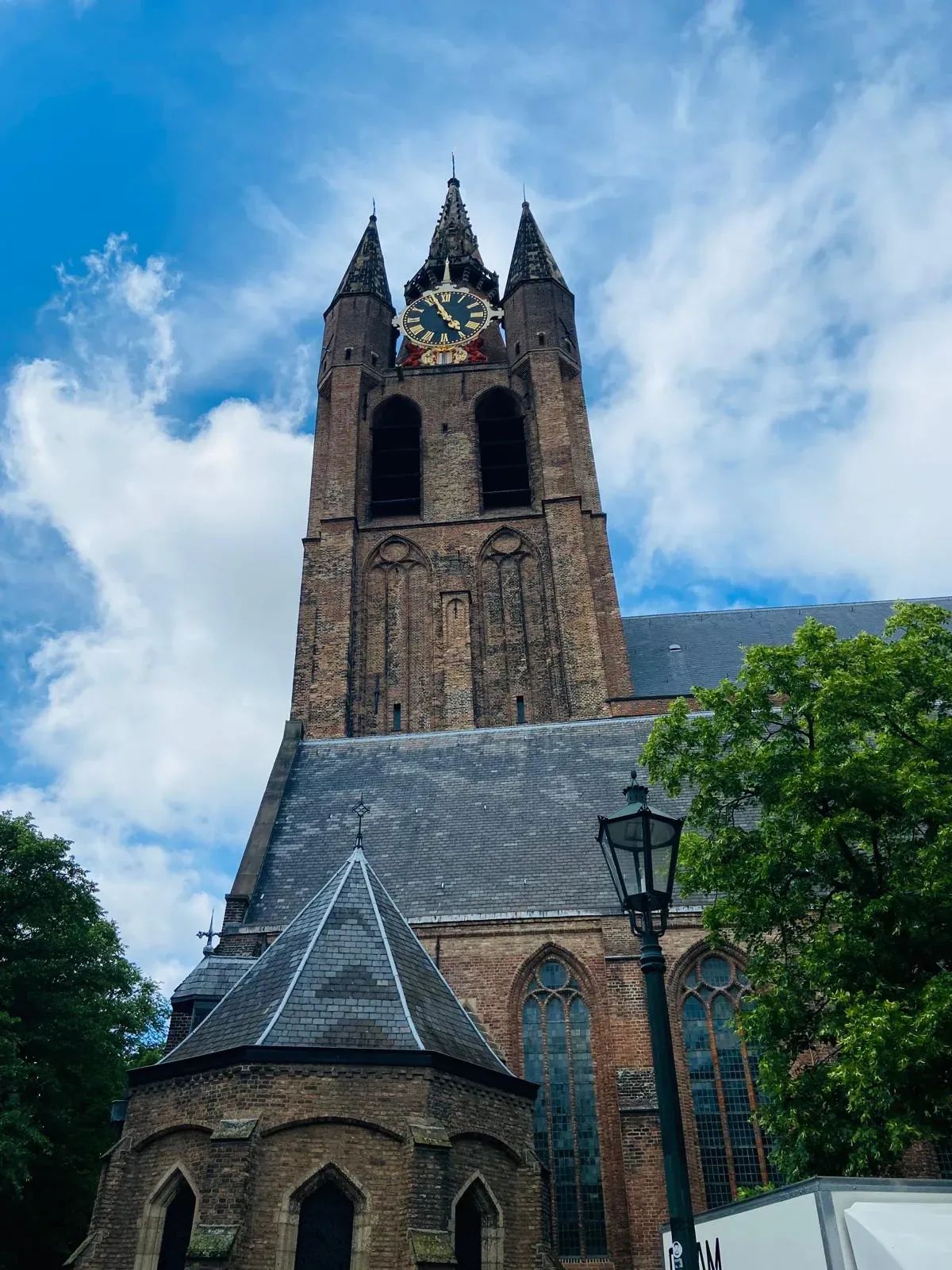
Oude Kerk, Heilige Geestkerkhof. Vermeer was buried here on 15 December 1675 in his mother-in-law’s family grave. For centuries only a small stone marked the spot; a larger memorial was added in 2007. Van Leeuwenhoek’s tomb is in the same church. Both churches are open to visitors Monday to Saturday (10:00–17:00 from February to October) on one combined ticket of €10.00; see the Oude and Nieuwe Kerk site for winter hours and the tower.
The Delft Thunderclap of 1654
On 12 October 1654 the city’s gunpowder store exploded, flattening the north-east quarter of Delft and killing more than 500 people. Among the dead was Carel Fabritius, Rembrandt’s most gifted pupil, who had settled in Delft and painted The Goldfinch the same year. He was 32 and only about a dozen of his paintings survive. Whether Vermeer knew or studied with Fabritius is debated, but the loss of the older painter left Vermeer as the city’s leading artist within a few years. The blast site is now the Paardenmarkt and Doelenplein area, five minutes north-east of the Markt; there is nothing to see of the explosion itself, but the open space is a direct result of it. The Goldfinch hangs beside the View of Delft in the Mauritshuis.
Where are Vermeer’s paintings today?
| Painting | Where | Notes |
|---|---|---|
| View of Delft | Mauritshuis, The Hague | Room 15; 10 minutes from Delft by train |
| Girl with a Pearl Earring | Mauritshuis, The Hague | On loan abroad 15 August to 4 October 2026; museum closed for maintenance 24 August to 20 September 2026 |
| The Milkmaid | Rijksmuseum, Amsterdam | About 1660 |
| The Little Street | Rijksmuseum, Amsterdam | About 1658 to 1659 |
| Everything else | Museums in Europe, the US and Japan | None in Delft |
The Mauritshuis is the natural second half of a Vermeer day. Our guided Mauritshuis visit takes you through the collection with a guide, and the private tour of The Hague and Delft combines the painter’s city in the morning with his paintings in the afternoon.
A Vermeer walk in 90 minutes
If you want to do it yourself, this order works and involves no backtracking:
- Station to the Hooikade viewpoint (5 minutes). Look north.
- Walk into the centre along the Oude Delft to the Oude Kerk (15 minutes). Vermeer’s grave.
- Through the Hippolytusbuurt to the Voldersgracht: the Flying Fox at number 25, the Vermeer Centrum at number 21.
- Onto the Markt: Mechelen’s site at 52 to 54, then into the Nieuwe Kerk for the baptismal font and the tower.
- Behind the church to the Oude Langendijk and the site of the Thins house, then east along the canals to Vlamingstraat 40 to 42 for the Little Street.
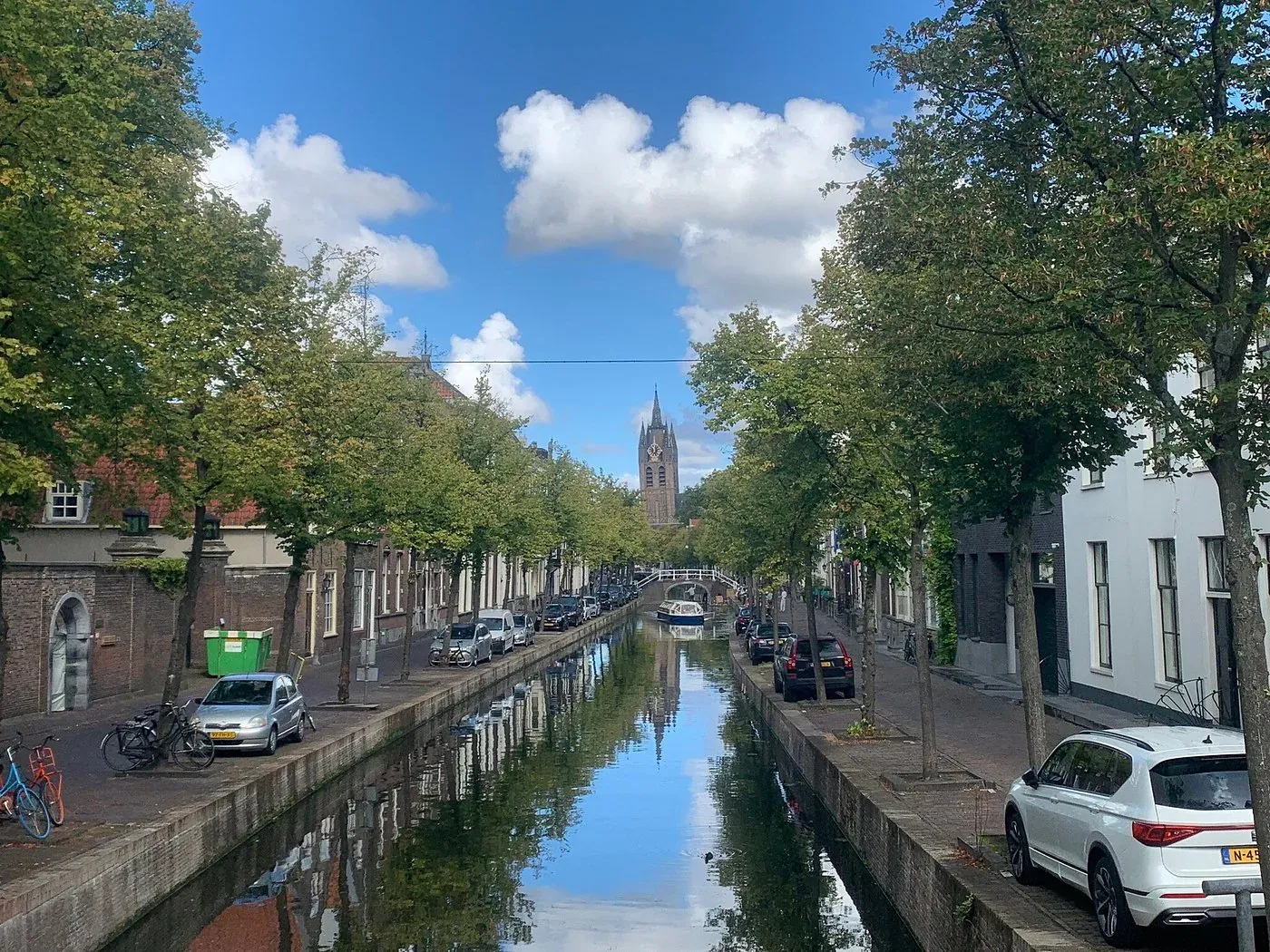
The self-guided audio tour of Delft covers most of these stops with narration, and the Vermeer’s Delft private tour does the whole route with a guide who can talk about the paintings as well as the places.
Frequently asked questions
Are there any Vermeer paintings in Delft?
No. The Vermeer Centrum shows full-size reproductions of all his work but owns no originals. The nearest real Vermeers are the View of Delft and Girl with a Pearl Earring in the Mauritshuis in The Hague, ten minutes away by train, and the Milkmaid and the Little Street in the Rijksmuseum in Amsterdam.
Can I see the exact view from the View of Delft?
Yes, from the Hooikade on the south bank of the Kolk, a few minutes from the station. A marker shows the spot. The city gates in the painting were demolished in the 19th century, but the Nieuwe Kerk tower and the line of the water are unchanged, and morning light gives the closest match.
Where is the house from Girl with a Pearl Earring?
Nowhere. The painting is a tronie, a study of a head and costume, not a portrait of a known person in a known place, and the plain dark background gives no location. If it was painted anywhere, it was in Vermeer’s studio in the Thins house on the Oude Langendijk, which no longer exists.
Why is the Little Street address only known since 2015?
Because the houses were rebuilt and the painting shows no landmark. Frans Grijzenhout solved it by measuring the frontages against a 1667 register of canal dues that recorded every house width on the Vlamingstraat, then matching the owner of the right-hand house to Vermeer’s aunt. The Rijksmuseum and Museum Prinsenhof exhibited the finding in 2015 and 2016.
Is Vermeer’s grave marked?
Yes. In the Oude Kerk there is a floor stone from 2007 with his name, in addition to the small original marker. He was buried on 15 December 1675 in the grave of his mother-in-law’s family, so there is no separate tomb of his own.
How long does a Vermeer visit to Delft take?
Ninety minutes for the walk above without going inside anywhere; half a day if you add the two churches and the Vermeer Centrum. Add an afternoon in The Hague for the Mauritshuis and you have a full Vermeer day.
See Delft with a Discover Delft guide
The Vermeer’s Delft private tour follows the painter’s life through the streets he knew, with a guide who can put the paintings in front of you on a tablet at each spot. If you want the broader story of the town, the private walking tour of Delft covers Vermeer alongside William of Orange and Delft Blue. Our guides work in English, Dutch, German, French, Italian and Spanish.
Ready to see Delft with a private guide?
See our tours