
The Delft Thunderclap of 12 October 1654: the morning a gunpowder store took a quarter of the city with it
· by Robin Lenskens · Updated
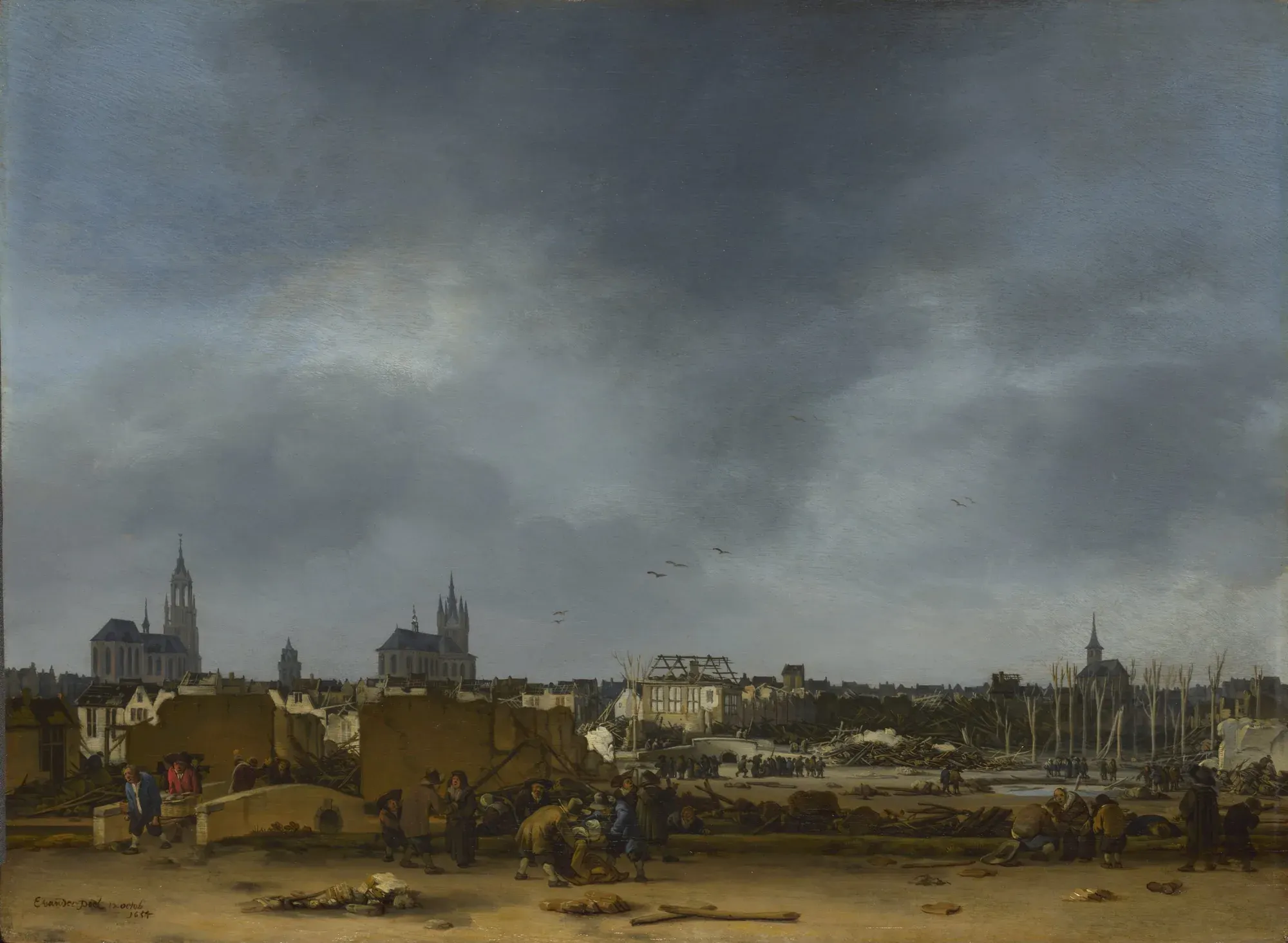
Late on the morning of Monday 12 October 1654, a gunpowder magazine in the north-east corner of Delft exploded. It held between 80,000 and 90,000 pounds of black powder, roughly 40 tonnes, in the cellar of a former convent on the site of today’s Paardenmarkt. The blast flattened the surrounding Doelenkwartier, destroyed around 200 houses and damaged hundreds more, blew out the stained glass of the Oude and Nieuwe Kerk, and was heard as far as Texel, 150 kilometres to the north. Nobody knows how many people died; estimates range from at least a hundred to several hundred. The painter Carel Fabritius, aged 32, was among them. Today the site is the open square of the Paardenmarkt, five minutes’ walk north-east of the Markt, and the replacement powder house built outside the walls in 1660 still stands beside the Schie.
Why was there a gunpowder magazine in the middle of a city?
Because Delft was an arms town. In the 17th century it stored weapons and powder for the States of Holland, and the former convent of St Clara, the Clarissenklooster, was one of six magazines inside the walls. This one was known as Het Secreet van Holland, the Secret of Holland. Essential Vermeer notes that it had held powder since at least 1637 and stood in the Doelenkwartier, the quarter named for the Schuttersdoelen, the militia training ground beside the convent land. The convents had been closed after Delft went over to the Protestant side in 1572, their cellars were thick-walled and vaulted, and the city needed somewhere to put the stock. The Armamentarium on the Oude Delft, the arsenal begun in 1601 and enlarged in 1692 and one of the largest weapons depots of the Republic, shows how much of the Republic’s hardware sat inside one small city.
What happened on the morning of 12 October 1654?
The keeper of the magazine was Cornelis Soetens. That morning he went into the store with a colleague from The Hague to take a sample of powder, by one account two pounds of it, for inspection. The New Netherland Institute puts the sequence plainly: the two men entered the building, and roughly half an hour later the magazine exploded.
What set it off is not known. The usual explanation is a spark or flame from a lantern, and that is plausible, but it is a reconstruction, not a finding. No eyewitness account from inside the magazine survives. Even the time differs by source: Essential Vermeer says just before half past ten, the Historians of Netherlandish Art review of the 2004 Fabritius exhibition says between ten and half past ten, and the Rijksmuseum caption to its Van der Poel painting says around half past eleven. All agree it was a Monday morning, with the city at work.
How big was the explosion?
The quantity of powder is one of the better-documented figures. The New Netherland Institute gives 80,000 to 90,000 pounds, about 40 tonnes; the Rijksmuseum says 90,000 pounds; the National Gallery in London says about 40,000 kilograms. The New Netherland Institute puts the force at some 22.5 tonnes of TNT, and the sound carried to Texel, more than 150 kilometres away. The name the city gave it, the Delftse Donderslag, the Delft Thunderclap, remembers the sound rather than the sight.
What was destroyed?
The Doelenkwartier ceased to exist. The Verwersdijk, Doelenstraat and Geerweg were flattened and the Schuttersdoelen was wiped out. The New Netherland Institute’s figures are around 200 houses razed and another 300 damaged, a quarter of the city; the Historians of Netherlandish Art review says roughly a third. Museum Prinsenhof Delft’s catalogue says almost no building in Delft came through undamaged. Both the Oude Kerk and the Nieuwe Kerk lost their stained glass, which is why neither has much old glass today.
The damage reached the Markt. The Mechelen inn where Johannes Vermeer had grown up, and where his mother Digna Baltens still lived, was assessed at 150 guilders of damage, for which, according to Essential Vermeer, she received 60 guilders. The States of Holland and West Friesland put 100,000 guilders towards the recovery.
How many people died?
Nobody can answer this, and it is better to say so than to pick a number. No list of the dead survives; many bodies were never found or were unrecognisable. The estimates in print disagree by an order of magnitude:
- The New Netherland Institute says at least a hundred dead and thousands injured.
- The National Gallery in London says that although no records survive, hundreds must have been killed.
- The Mauritshuis says probably over 500.
- A figure of 1,200 appears in some popular accounts, including a 2010 Radio Netherlands Worldwide piece, with no archival basis given.
At least a hundred people died, probably several hundred, and anyone who gives a precise figure is guessing.
Who was Carel Fabritius, and how did he die?
Carel Fabritius was born in Middenbeemster in 1622 and trained in Rembrandt’s Amsterdam studio in the early 1640s. The Mauritshuis calls him one of Rembrandt’s most talented pupils. After losing his first wife and three children he remarried and moved to Delft in 1650, joining the Guild of St Luke in 1652 and paying only six of the twelve guilders due. In Delft his painting changed: the dark Rembrandt manner gave way to pale grey and ochre, cool daylight and experiments in illusion.
On 12 October 1654 he was at work in his house on the Doelenstraat, close to the magazine, painting a portrait of Simon Decker, the former sexton of the Oude Kerk. The house came down on them. The Historians of Netherlandish Art review of the 2004 Fabritius exhibition records that his sitter, his pupil Mathias Spoors and members of his household died with him; the Mauritshuis says he was rescued from the ruins so badly injured that he died soon after. He was 32.
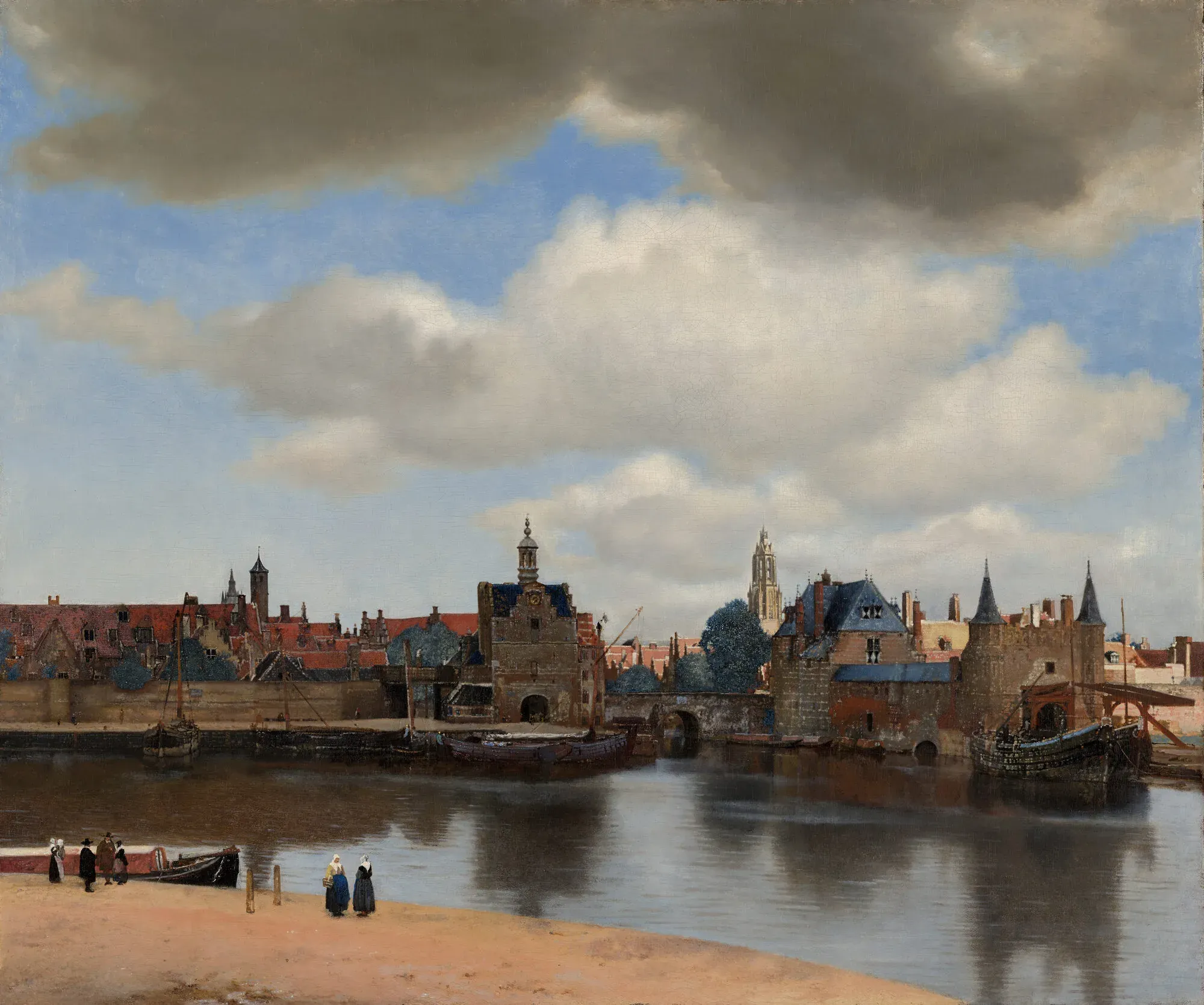
Only about twelve paintings by him survive, just four of them from his Delft years. Two are easy to see. The Goldfinch, painted in 1654, hangs in Room 14 of the Mauritshuis in The Hague, about a quarter of an hour from Delft by train. A View of Delft, painted in 1652, is in the National Gallery in London. It shows the Nieuwe Kerk from the corner of the Oude Langendijk and Oosteinde, with an instrument seller in the foreground, distorted as if through a wide-angle lens and probably made for a perspective box. Whatever else he painted in Delft most likely died with him.
Who painted the ruins?
Two Delft painters made the explosion their subject. Egbert van der Poel, born in Delft in 1621, painted the view across the devastated quarter towards the surviving towers of the Nieuwe Kerk, the town hall and the Oude Kerk, with the dead and injured among the rubble. Then he painted it again, and again. The National Gallery, which owns one version, says more than 20 survive, with the same ruined buildings and different figures. The Rijksmuseum owns another, dated 1654 to 1660, and its caption records that Van der Poel’s daughter Lysbeth died in the explosion; the National Gallery is more cautious, saying he may have lost a daughter who died in 1654. After 1654 almost everything he painted was fire and smoke at night.
Daniel Vosmaer, also Delft-born, around 1630, painted the ruined quarter as well. His view of the ruined quarter is in the collection of Museum Prinsenhof Delft, alongside a Van der Poel version. The museum is currently closed for renovation, so check before planning a visit around it.
These are not neutral documents; Van der Poel was selling a picture people wanted. But the topography matches the written accounts, and without them we would have little idea what the quarter looked like in the weeks after.
How was Delft rebuilt?
The city cleared the quarter, settled compensation street by street, and did not rebuild the magazine. The convent land became an open space used as a horse market, the Paardenmarkt, and the Schuttersdoelen was rebuilt a little to the south on what is now Doelenplein.
The powder went outside the walls. In 1660 Pieter Post, the architect of the Mauritshuis, built a new Kruithuis for the States of Holland beside the Schie south of the town, at what Essential Vermeer calls a cannon shot’s distance from the city. The national monuments register describes a gate tower that is both a water gate and a land gate, with two brick powder houses standing in a large water basin. It is a national monument, used today by the Delft scouts.
The city was largely rebuilt in brick and stone within twenty years. Delft did not grow back to what it had been; its economy was already past its peak, and the explosion came on top of a slow decline rather than causing it. But the streets filled again, and most of the north-east quarter you walk through today dates from that rebuilding and later.
What can you see today?
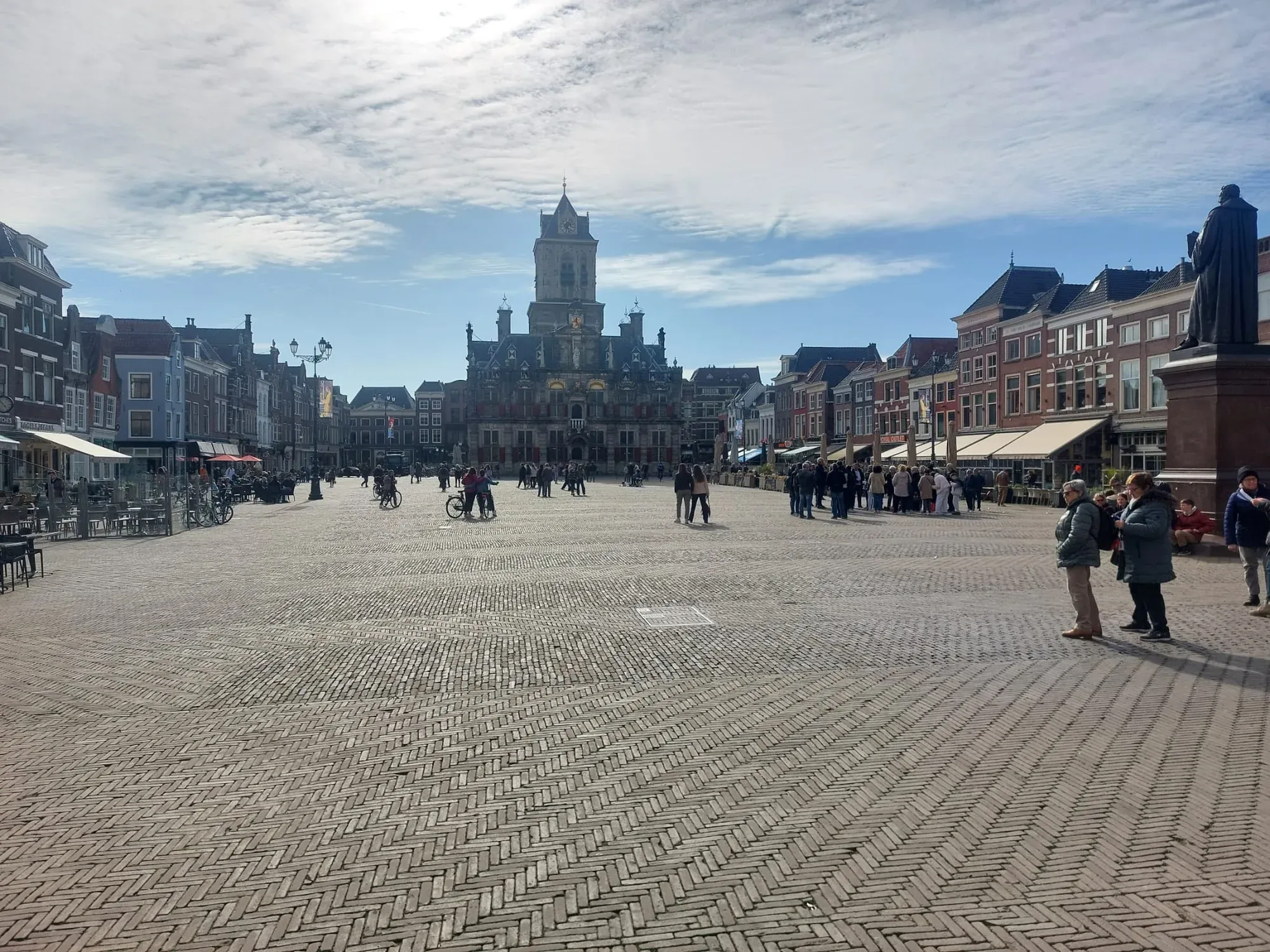
- The Paardenmarkt. The open square five minutes north-east of the Markt is the site of the magazine. Nothing of the convent survives above ground.
- Doelenplein and the Doelenstraat. The rebuilt militia ground and the street where Fabritius lived and died; the buildings are later.
- The Oude Kerk and Nieuwe Kerk. Both lost their glass in 1654; the windows you see now are 19th and 20th century.
- The Armamentarium, Oude Delft. The surviving arsenal, now a hotel, with its 1692 reliefs facing the canal.
- The Kruithuis, beside the Schie. Pieter Post’s 1660 replacement magazine, about two kilometres south of the centre. Not normally open, but visible from the road, and it opens on Open Monumentendag in September.
- The Goldfinch, Mauritshuis, The Hague. Room 14, about a quarter of an hour by train. Our private Mauritshuis tour puts a guide beside you in front of it.
We could not verify a plaque to the explosion or to Fabritius on the Paardenmarkt, so do not go looking for a monument. The square is the monument.
Where was Vermeer in all this?
In Delft, as he was all his life. Vermeer had been baptised in the Nieuwe Kerk on 31 October 1632, so on 12 October 1654 he was 21, a few weeks short of 22, married for eighteen months and a guild master for ten. None of his known paintings is dated before 1654.
Tradition links him to Fabritius, and the source is specific. In 1667 the Delft printer Arnold Bon published a poem on Fabritius in Dirck van Bleyswijck’s Beschryvinge der Stadt Delft, mourning the painter who died in the explosion and ending with Vermeer, who in the first printing “masterfully trod in his path” and in a revised state “masterfully emulated him”. Essential Vermeer’s page on Van Bleyswijck sets out both readings. That is where the idea of Vermeer rising from Fabritius’s fire comes from. It says that Delft saw Vermeer as his successor. It does not say he was his pupil, which Essential Vermeer judges unlikely; the Mauritshuis speaks of a dialogue between the two rather than one-way influence.
What is not in doubt is that Vermeer painted almost all of his known work, about 37 paintings, in Delft after 1654, and that a large part of it went to one couple in the city. According to Essential Vermeer’s page on his patrons, Pieter van Ruijven and Maria de Knuijt are thought to have acquired about half of his output; 21 Vermeers from their collection were sold in Amsterdam in 1696. Van Ruijven lent the Vermeers 200 guilders in 1657, and Maria de Knuijt left the painter 500 guilders in her will of 1665, which recent research reads as a sign that she, as much as her husband, was the collector. For where to stand in Delft for his paintings, see Vermeer’s Delft; for the longer arc of the town, the history of Delft.
Frequently asked questions
When exactly was the Delft Thunderclap?
Monday 12 October 1654, late in the morning. Most sources put it between ten and half past ten; the Rijksmuseum says around half past eleven.
What caused the explosion?
Nobody knows. The keeper, Cornelis Soetens, had gone in with a colleague about half an hour earlier to take a sample of powder. A lantern spark is the usual guess. No account from inside the magazine survives, so the cause stays a reconstruction.
How much gunpowder was stored there?
Between 80,000 and 90,000 pounds, roughly 40 tonnes, a figure the New Netherland Institute, the Rijksmuseum and the National Gallery agree on.
How many people died in the Delft explosion of 1654?
Unknown. Estimates range from at least a hundred (New Netherland Institute) to hundreds (National Gallery) to probably over 500 (Mauritshuis). The 1,200 sometimes quoted has no archival basis that we can find.
Can I see the site of the explosion?
Yes. It is the Paardenmarkt, an open square in the north-east of the old town, five minutes from the Markt. Nothing of the magazine survives. The 1660 replacement, the Kruithuis, stands beside the Schie about two kilometres south.
Where is the Goldfinch?
In Room 14 of the Mauritshuis in The Hague, about a quarter of an hour from Delft by train. Fabritius painted it in 1654, the year he died.
Walk the ground with a Discover Delft guide
The Vermeer’s Delft private tour takes in the Paardenmarkt and the Doelenkwartier alongside the Vermeer sites, with a guide who can show you the Van der Poel and Vosmaer views of the ruins where they were painted; see the tour info page for prices and booking. The private walking tour of Delft covers the explosion as part of the wider story of William of Orange, Delft Blue and the Golden Age, and the self-guided audio tour of Delft lets you do it at your own pace. Our guides work in English, Dutch, German, French, Italian and Spanish.
See it with a private guide
Highlights of Delft
Join our guide on a 2-hour walk past every highlight of Delft. This is the classic tour, and it is a story rather than a history lesson.
Free cancellation up to 24h before
Vermeer's Delft
Walk in Vermeer's footsteps, from where he was born to where he lived, and from the Little Street to his grave. You will see his work differently after.
Vermeer Centre entry included
Free cancellation up to 24h before
Ready to see Delft with a private guide?
See our tours