What does Delft mean? The history of Delft, from a dug ditch to Delft Blue
September 9, 2026 · by Robin Lenskens
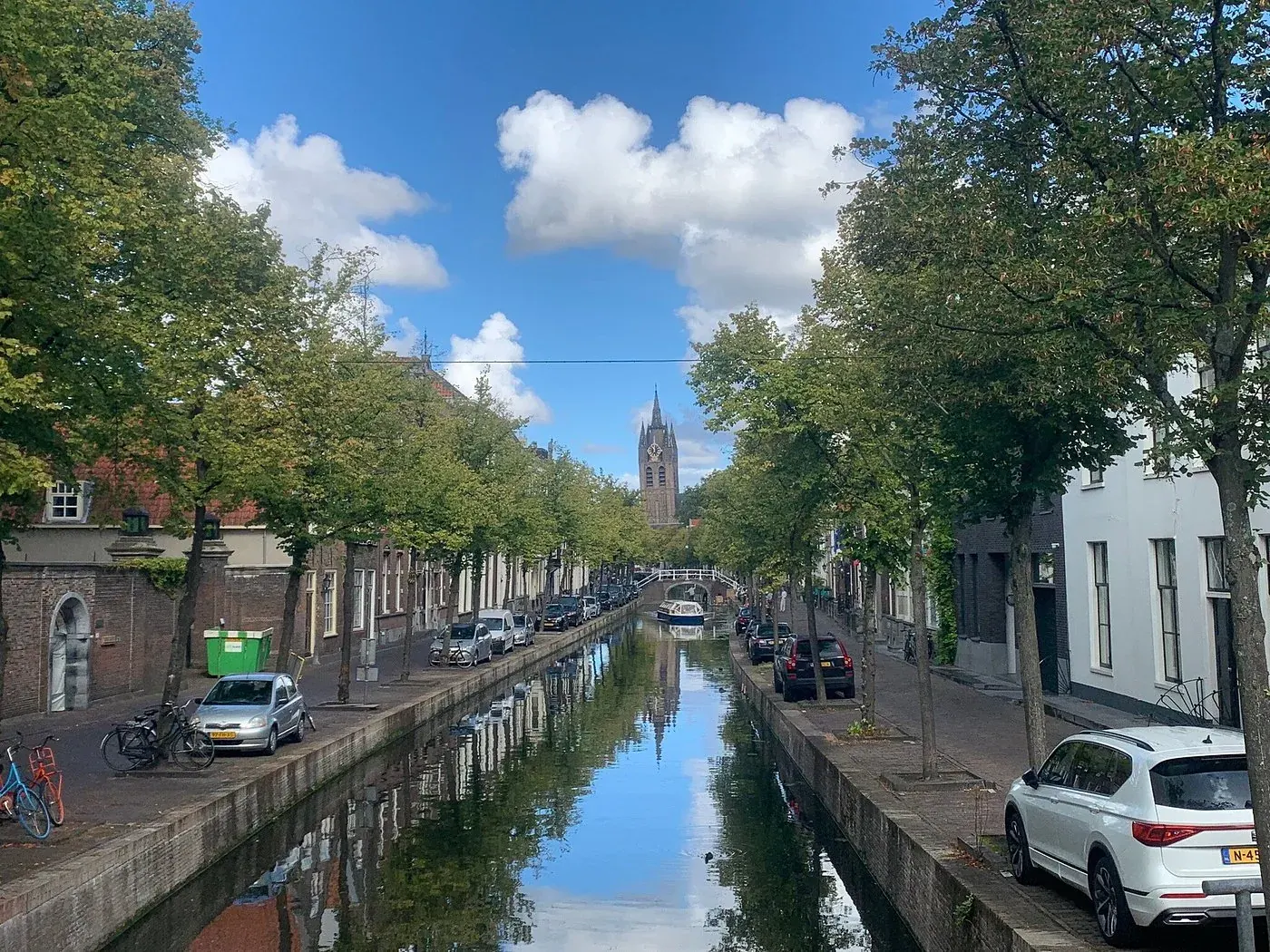
Delft is named after a ditch. The Dutch verb delven means to dig or to delve, a delf was a dug watercourse, and the settlement that grew along one of them took the name of the water. That canal still runs through the middle of town under the name Oude Delft, the oldest canal in the Netherlands, and it is the first thing we point at on almost every tour. The rest of the city’s history hangs off that one fact: dig a canal, trade along it, get rich, build in brick, and 800 years later people come to photograph it.
The short answer
- What does Delft mean? A dug ditch or canal, from delven, to dig. The Oude Delft is that canal.
- How old is Delft? The settlement dates from the 11th century. It was granted city rights on 15 April 1246, so the town is coming up on 800 years as a city.
- What is Delft known for? Delft Blue pottery, the painter Johannes Vermeer, the burial church of the Dutch royal family, the microscopes of Antonie van Leeuwenhoek, and one of Europe’s leading technical universities.
From a dug ditch to a market town
The Oude Delft was dug some time before 1100, probably to drain the peat and to move goods between the Schie and the villages inland. A count’s court stood at one end of it, farms along the rest. By the early 1200s the settlement had a market, a church and a reason to exist beyond farming.
Count William II of Holland granted Delft its city rights on 15 April 1246. That gave the town its own court, its own market and the right to defend itself, and the shape you walk through today follows directly from it: a grid of canals with the Markt at the centre, the Oude Kerk on the old canal and, from 1381, the Nieuwe Kerk on the square.
Delft made its money from beer, cloth and later from the Dutch East India Company, which had one of its six chambers here. At its 16th-century peak the town counted around 200 breweries, which is why so many canal houses are wider than their neighbours: they were built to roll barrels through.
Then, on 3 May 1536, a fire that started in the north of town burned for days and destroyed a large part of it. Most of the wooden Delft went up. What replaced it was brick, which is why the centre now reads as one continuous 16th and 17th-century streetscape rather than a medieval one.
The city where a country lost its founder
In 1572, during the revolt against Spanish rule, William of Orange made Delft his base and moved into the former Saint Agatha convent, now the Prinsenhof. On 10 July 1584 Balthasar Gerards shot him on the stairs of that building. The bullet holes are still in the wall, and visitors stand in front of them every day of the week.
He was meant to be buried in Breda, but Breda was in Spanish hands, so the Nieuwe Kerk in Delft took him instead. That accident of war made Delft the burial place of the House of Orange-Nassau. Almost every Dutch monarch since has been carried into the royal crypt under the church, most recently Prince Bernhard in 2004 and Princess Juliana and Prince Claus before him. The crypt itself is closed to the public; the marble mausoleum above it, finished in 1623 by Hendrick de Keyser and his son, is not.
The Golden Age: painters, microscopes and porcelain
Two men were born in Delft in the same year, 1632, a few streets apart.
Johannes Vermeer spent his whole life in the town and painted about 35 surviving pictures, several of them looking straight at it. The View of Delft and Girl with a Pearl Earring now hang in the Mauritshuis in The Hague, ten minutes away by train, and the Little Street is in the Rijksmuseum. Nothing original hangs in Delft itself, which surprises people; the Vermeer Centrum on the Voldersgracht shows full-size reproductions of every painting and stands on the site of the Guild of Saint Luke where he was registered.
Antonie van Leeuwenhoek sold cloth, served the city as a minor official, and ground lenses in his spare time that were better than anyone else’s in Europe. Through them he was the first person to see bacteria, sperm cells and the structure of muscle. He is buried in the Oude Kerk, a few metres from Vermeer, and he is the reason the phrase Father of Microbiology gets used on this town’s tourist signs.
Delft Blue started as an imitation. Ships of the East India Company had been bringing Chinese blue and white porcelain into the country since around 1600, the Dutch were hooked on it, and when the fall of the Ming dynasty interrupted the supply in the 1640s the local potters filled the gap. What they made is not porcelain: it is earthenware with a white tin glaze, painted in cobalt and fired again. At the height of it, in the second half of the 17th century, Delft had more than 30 potteries. One is left. De Porceleyne Fles, founded in 1653 and known today as Royal Delft, still paints by hand on the Rotterdamseweg, and you can watch it happen.
The Thunderclap of 1654
On 12 October 1654 the city’s gunpowder store, roughly 30 tonnes of it in a former convent at the north-east edge of town, exploded. The blast was heard on the islands of Texel, more than a hundred kilometres away. It levelled a whole quarter, killed more than a hundred people and injured thousands.
Among the dead was Carel Fabritius, Rembrandt’s most gifted pupil and the painter of The Goldfinch, who was working in his studio nearby. Most of his output went with him; about a dozen paintings survive. The open, green Doelenplein area where the magazine stood was never rebuilt to its old density, and that quiet gap in the street plan is the explosion’s last trace.
The quiet centuries, and the university
After the Golden Age, Delft slid gently downhill for 150 years. The breweries closed, the potteries closed, and the money moved to Rotterdam and Amsterdam. That decline is the reason the centre looks the way it does: nobody had the funds to knock it down and rebuild, so the 17th century survived by neglect.
The city’s second act began in 1842, when King William II founded a Royal Academy here to train engineers for the colonial service. It became the Polytechnic School, then Delft University of Technology, and it now has around 27,000 students in a campus immediately south of the old town. Delft today is two cities laid on top of each other: a small historic centre that looks like a museum, and one of the largest concentrations of engineering research in Europe half a kilometre away.
The Second World War left the centre almost untouched, unlike Rotterdam 12 minutes down the line. That is the last piece of luck in the story, and the reason a walk through Delft still works as a walk through the 17th century.
Where to see this history today
| What | Where | Why it matters |
|---|---|---|
| Oude Delft | Runs north to south through the centre | The dug ditch the city is named after, and the oldest canal in the country |
| Prinsenhof | Sint Agathaplein 1 | Where William of Orange was shot in 1584. Closed for renovation until at least 2027 |
| Nieuwe Kerk | Markt | The mausoleum of William of Orange and the royal crypt below it |
| Oude Kerk | Heilige Geestkerkhof | The graves of Vermeer and Van Leeuwenhoek, under a tower that leans about two metres |
| Vermeer Centrum | Voldersgracht 21 | Every Vermeer at true size, on the site of the painters’ guild |
| Royal Delft | Rotterdamseweg 196 | The last of the 17th-century potteries, still painting by hand |
| Doelenplein | North-east of the centre | The empty ground left by the 1654 explosion |
Frequently asked questions
What does Delft mean in Dutch?
It comes from delven, to dig. A delf was a dug ditch or canal, and the town took its name from the one it grew along, the Oude Delft. The English word delve is a direct cousin.
How old is Delft?
There was a settlement here in the 11th century, and the town received city rights on 15 April 1246. The Oude Kerk was begun in the 13th century and the Nieuwe Kerk in 1381.
Is Delft Blue actually porcelain?
No. Real porcelain needs a specific white clay and a much higher firing temperature. Delft Blue is earthenware covered in a white tin glaze and painted with cobalt, which was the closest 17th-century Dutch potters could get to the Chinese original. Our guide to buying real Delft Blue explains how to tell the hand-painted pieces from the transfer-printed ones.
Why is William of Orange buried in Delft and not in Breda?
The family vault was in Breda, but the town was held by Spanish troops in 1584. Delft, where he had been living and where he was killed, took the burial instead, and the House of Orange-Nassau has used the Nieuwe Kerk ever since.
What is Delft famous for today?
Delft Blue, Vermeer, the royal burial church, Van Leeuwenhoek’s microscopes and the technical university. For a small town of about 105,000 people, that is a lot of history per square kilometre, and all of it fits inside a 20-minute walk.
Is Delft worth visiting?
Yes, and it is quieter than Amsterdam by a wide margin. Half a day covers the centre, a full day adds Royal Delft and the canals. We wrote a timed plan for that in Delft in one day.
Hear this on the street where it happened
Reading about the Thunderclap is one thing. Standing on the ground it cleared, five minutes from the stairs where William of Orange was shot, is another. Our private walking tour of Delft covers this whole story in two hours, at your own pace and in your own language, and the Delft and Royal Delft tour carries it on to the last working pottery with entry included. If you would rather go alone, the self-guided audio tour of Delft tells it in your ear for a few euros.
Ready to see Delft with a private guide?
See our tours